Showing posts with label Bandai. Show all posts

3/5/26

ULTRAMAN TARO: GREAT MONSTER THE 30 (Bandai, 1991)


Here is an item that took me by surprise.  You may recall that we reviewed both the ULTRAMAN and ULTRASEVEN "Great Monster the 30" figure sets, a while back, but I didn't know this existed!

So these are 30-figure sets that are basically "keshi," a category of soft rubber, gashapon-type Japanese figures (sometimes even including erasers). Each set includes the hero Ultra, and 29 kaiju from his series.

To American eyes, these are highly reminiscent of the awesome M.U.S.C.L.E. 28-packs that we had over here (and hey, those were connected to Bandai too, so there you go):


Back to our set at hand, here is the back of the box:


While the previous two sets included a die and a colorful game board, enabling you to play a board game with the figures (because Japan), this one does not, and instead gives you a heavy sheet of die-cut labels:


Interestingly, there isn't very much "Taro" content in the stickers...in fact, all of the kaiju pictured are from other shows.  There is good reason for this, because by this point in the lineage, the shows were beginning to show some fatigue, and the enemy designs were starting to suffer.  There were still some high points, but some were just forgettable. Lots of feathers and dangly things.

Here are the contents of the set.  How many can you name? The answer for me is, "precious few." And I will admit it!


After puzzling over these, I went to the booklet for the blu-rays, and then realized lots of the spellings are pretty knackered up, so I resorted to correcting as many of these as I could via online sources...so here are the names:


So my main take-away from this is:  does this mean there is a RETURN OF ULTRAMAN set (Jack, that is) that exists somewhere? If so, sign me up.  The first three shows were the best. It makes me wonder how many of the classic shows had sets in this line.  It's extremely hard to find any information online about these, but I am digging away.

As you can probably tell, I have sort of a love-hate relationship with the last few classic Ultra shows.  They tend to be hit-and-miss sometimes.  With Taro, it seems like he is always having to be rescued by his mama. I was still very happy to discover this one, though.  I will always take more classic Ultra!

4/28/23

ULTRASEVEN: GREAT MONSTER THE 30 (Bandai, 1990)


So here is the OTHER of the two Bandai boxed sets, and it follows the exact same path as the Ultraman one:  30 figures, a die, and a gameboard, all in a box of awesomeness.

The back of the box is more accurate this time as well (the last one showed enemies that weren't in the set)

ULTRASEVEN is, without a doubt, a magical high point in the long lineage of Tsuburaya's flagship franchise.  We could discuss why all day, but every time I revisit it, I am overwhelmed by the feeling that something special was going on, and everybody involved was aware of it.  I have a particular fondness for the third series (THE RETURN OF ULTRAMAN, later to be named JACK), but somewhere in the middle--or possibly just after--it, the original golden age of Ultra concluded.  You could argue that the limit should be extended all the way to the more natural original ending point of ULTRAMAN TARO, but admittedly by then the series was in a major repetitive rut (not to mention the many outside forces affecting the quality and production of the show, such as oil crises and kaiju falling out of fashion).

But back to our boxed set--the show gave us many innovative creature designs, and several that have stood the test of time.  How many enemies can you name?


Once again, I pretty much failed and had to cheat, so here are the answers:


Like last time, there were some major favorites that didn't make the cut, such as:

Crazygon, the giant car-eating robot (who's probably hard to make a figure of), Miclas (who is not a foe, but actually a helper to Ultraseven), and--the design of all designs--my hero, DINOSAUR TANK.  

Bandai doesn't appear to have continued these boxed sets, which is really too bad, as there was definitely more ground to cover.  


MUCH LATER EDIT: In re-reading this post, I realized I left out the gameboard that is included with this set! Here it is, in all its glory:


4/24/23

ULTRAMAN: GREAT MONSTER THE 30 (Bandai, 1990)


We alluded to these great sets from 1990 in our post about the M.U.S.C.L.E. toy line, but they are worthy of featuring on their own.  

It gets confusing for collectors, because all types of little rubber guys like this get lumped in under the word "keshi," which literally means eraser in Japanese.  And yet, while there are figures (often using the same molds) from retail sets and gashapon machines that are literal erasers, they aren't all made for that purpose (also, the erasers are usually brighter colors).  (Bandai had been making such sets for several years--here is an awesome Godzilla Comichara set from 1984 we featured ten short years ago!)  In the U.S. of course, we had the occasional gumball machine eraser, as well as the monster erasers made by Deiner, but I never wanted to use them for their intended purpose...why would I literally disintegrate my prized monster figure?

The obvious comparison to these 30-packs are the M.U.S.C.L.E. boxed 28-packs (which were actually larger in size, when compared).  There was also an Ultraseven set (stay tuned for that), although it would have been cool if Bandai would've just gone all the way and done an Ultraman Jack set as well, but it's obvious that the most iconic of Ultraman foes were created in those first couple of years.

Here is the back of the box, which strangely shows two enemies in the bottom row that aren't even in this set, Gabora and Kemular!

Before we get to the actual figures, here is the included game board, allowing you to play a game with your keshi army:


And now, the star of the show, the inner tray holding Ultraman and 29 of his adversaries:

How many can you name? Yeah, I got stumped on several of these too, so I cheated, and I'm not above admitting it.  Here is a glossary of everyone that's included (you may have to blow it up):


Some favorites didn't make it in, such as:


Gango (usually spelled Gyango, the totem-pole-decorated kaiju), or even Bemular, from the very first episode.  Also, you would expect a Pigmon.  I wouldn't want one, but you would expect one.

A very cool set! So, did the Ultraseven one measure up, or even surpass this one? Stay tuned for the answer!

3/2/23

M.U.S.C.L.E. (Mattel/Bandai, 1985-87)

I didn't know it way back in the day, but yet another of my favorite toy lines also came from Japan (doesn't everything?).  Back then, the whole line was shrouded in mystery, but today, we know its complete origins.

In 1985, completely out of nowhere and in the middle of a toy world dominated by 4-inch action figures, Mattel suddenly launched packages of 2-inch, flesh-colored, non-posable rubber wrestling figures, and a new toy line was born.  They christened it "M.U.S.C.L.E.," and went so far as to make it an acronym, standing for "Millions of Unusual Small Creatures Lurking Everywhere." Their permutations seemed endless, as did the amount of different figures available.  After all, they said "Millions" right there in the title! 

As it turned out, Mattel had entered into a partnership with Bandai (which wasn't their first) to bring figures from a popular Japanese franchise, Kinnikuman, to America.  Kinnikuman encompassed comics, animated series(es), toys, and much more, and had run for years (and still does).  Every figure had a name, and was a character from the long-running series' universe.  But instead of adopting the property, they simply dumped the figures on the toy-buying public.  They did bother to change the lead character to "Muscleman," and rename a character "Terri-Bull" to serve as the bad guy, but everything else, including the allegiance of each character, was up to you.  And you know what? It worked.

Like many folks, I prefer adaptations that are as accurate as possible for Japanese properties brought over here, but the lack of any information with this line really sparked kids' imaginations. You made your own teams; it was wide open for interpretation.  "Hey, this guy is a light bulb; this guy is made of bricks!" (One guy was actually a urinal, but we didn't know that at the time, and neither did Mattel, I'm sure.) One thing that Mattel/Bandai did right was to make the figures harder rubber, and much more durable.  In Japan, they were part of the "keshi" craze; soft rubber, eraser-like figures that come out of gashapon machines [see this post for an awesome Godzilla keshi set].

So how many figures were there? In that first year, a mail-order promotion began appearing, allowing you to order your own poster checklist, which revealed that there were 233 figures.  However, this wasn't the whole story, because the Wrestling Ring playset included 2 exclusive figures, and there is also one rare non-poster figure that somehow got in (and in recent years has been proven to exist in sealed packages), setting the officially-accepted count for a complete flesh-colored set at 236.

And, an entire set of 236 fits in an "oversized-shoebox" size archival box! We should do a post on everything we've learned about how to store things safely long-term (yes, they are all individually bagged, but don't buy your ziploc bags at Michaels or Wal-Mart. You want polypropylene, NOT polyethylene. 

[3/2024 UPDATE: And here is what a complete set looks like on display--turns out it takes up quite a bit of room to display 236 figures:]

After the first year, Mattel could've kept adding new figures, but instead the decision was made to re-issue existing figures in new colors.  Sometime during that second year, kids' interest waned, and the line folded and blew away in the wind.  It would've been interesting to see the animated series adapted and new figures issued, but it wasn't meant to be.

There is quite a bit of confusion over the colored figures; for example, not every figure is available in every color (in fact, far from it). Also, counting the original flesh color, there are ten different colors available, as can be seen below:


The light purple color is mega-rare, because only five figures were made that way, which we will get to in a moment.  First, let's talk about the ways that the M.U.S.C.L.E. (I hate typing that) figures were sold.


Four-packs were the most popular, because they were the cheapest, AND you could see what you were getting.  Much allowance was scrounged and maximized to buy as many four-packs as possible. Yards were mowed.


10-packs were sold in an opaque garbage can.  I never cared for these as a kid, because I couldn't see the figures I was purchasing (especially with the wrapper on).  The trash can may seem random, but it's actually another Bandai carry-over.  In Japan, assortments of keshi figures (usually Ultraman enemies, from what I've seen) were sold this way.


There were four different 28-packs, and they were the top of the line, and obviously the most expensive.  Unlike the other sizes, they were not randomly packed, and included figures you could get nowhere else.  This is a second-year example that included colored figures:


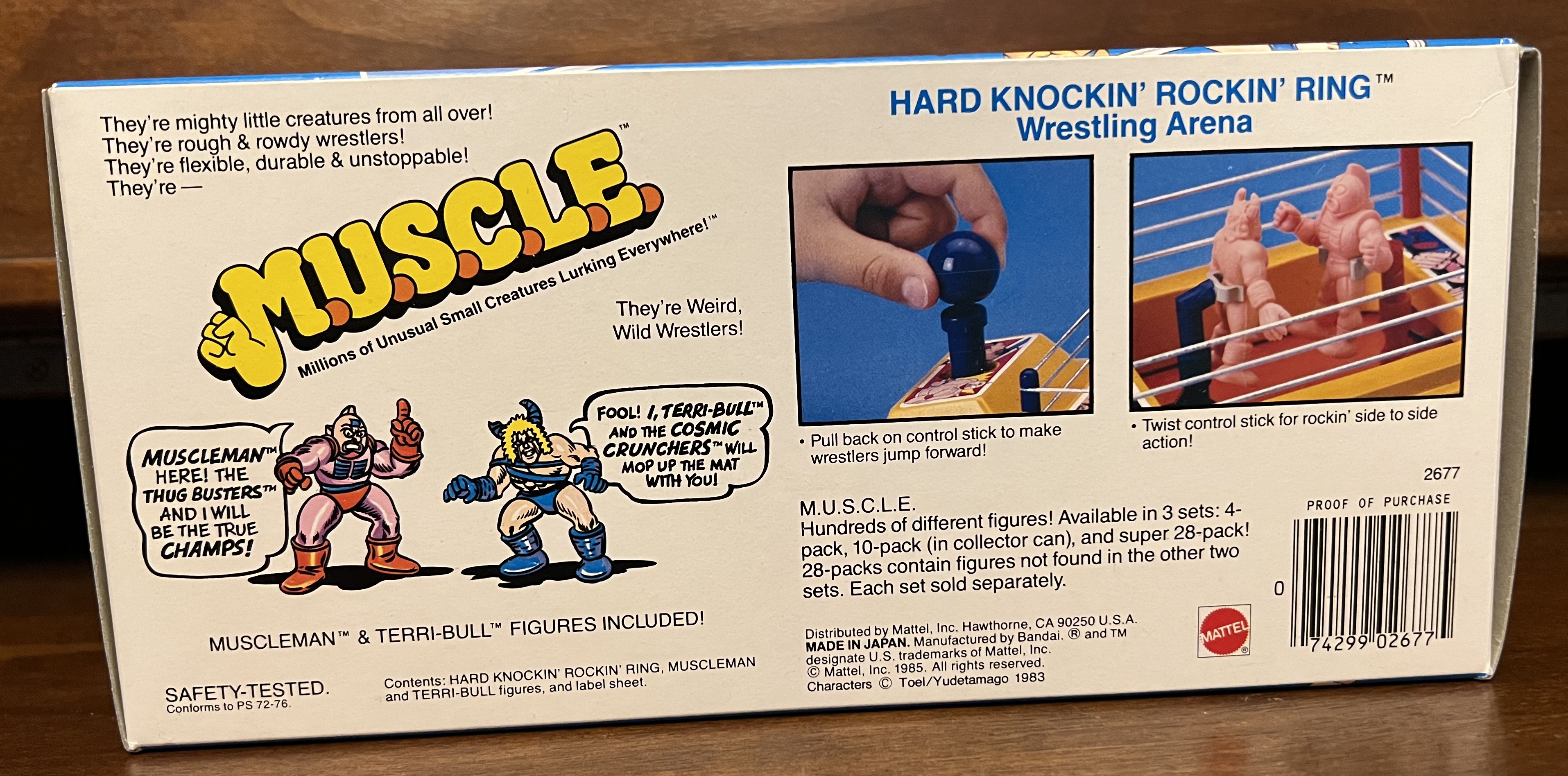
While the back of the 4-packs sets up the hero and villain, it was the back of the 28-packs that gave us the closest thing to a backstory, with an included comic strip! I suppose no other item in the line had enough room on its packaging:


Speaking of Bandai and keshi, the 28-packs always remind me of their awesome Ultraman sets (which are sets of 30 figures):


Every great toy line needs a playset, and the crown jewel of the M.U.S.C.L.E. toy line was what every fan wanted:  the wrestling ring.


It wasn't even that large of a playset, but the concept of joysticks to move your figures and make them fight was brilliant.  On paper. Unfortunately, it's probably for the best that I didn't get one that Christmas, as they are pretty fragile.  The plastic clips that hold the figures tended to break easily (intact examples usually have white stress marks, at the very least).  But that wasn't all:  the orange cardstock that served as the floor tended to get scratched up quickly, AND the elastic bands that made up the ropes around the ring were prone to breaking or getting lost.  


Bandai produced this item themselves for Mattel.  Notice that the back of the box shows a prototype version of the playset with different joysticks, and, most notably, different clips to hold the figures! Too bad we ended up with the fragile ones. (They really should've been metal.)

We mentioned the rare light-purple color.  There was also a board game, which included ten figures.  What's important here is that, while light green was already an existing color, the five lavender-colored figures in the game are the only ones ever produced that way.  Because of this, complete examples of the game can be tough to come by.


We have already mentioned the mail-away poster, but for completeness, there was also an NES game, a FREE figure in select jars of Nestle Quik (that was awesome), and something called the "Battlin' Belt" that was the Kenner Chewbacca Bandolier Strap of the M.U.S.C.L.E. line.  I see what they were going for, but I thought it was dumb, even as a kid.  However, these are the types of items that always end up worth a fortune, because fewer people bought them originally.  


All in all, one thing you can definitely say about this toy line is that it causes hardcore nostalgia.  It's certainly one of my favorites from the 1980's.  Discovering its origins and finally getting questions answered through some great websites (links below) has been extremely rewarding over the years.  I've noticed in recent years that you just don't run into the figures like you used to.  It used to be commonplace to see a couple in a random bag of toys in a thrift store, but that never happens to me anymore.  I'm sure they are being hoarded, because prices have been climbing! 

If you are interested in learning more--much more--about M.U.S.C.L.E., here are some places you should go:

The University of M.U.S.C.L.E. - This is the definitive website on the subject.  Do you want to know which figures were available in which colors? Are you curious which figures make up the different 28-packs? They have the answers.

Nathan's M.U.S.C.L.E. Blog - Jump to each figure by number, and see exactly how and where it was available! Great in-depth info also on each type of item in the line.

2/10/23

Ultraman Clash & Thrash City (Bandai, 1992)


Today we look at a special, dying breed of toy:  the GIANT PLAYSET.  The GP was the staple of many a stellar toy line for decades, but has become so "expensive" to produce that they are nearly extinct, and in some cases these days, laughable and made of cardstock. 

A bit of history first: in 1989, Tsuburaya decided to have another go at an English-language version of Ultraman, and entered into a co-production with a studio in Australia to film one "Down Under" the following year.  It took until 1992 to get the show into the United States via syndication, under the unwieldy title ULTRAMAN TOWARDS THE FUTURE, where its 13 episodes quickly came and went.

Nobody seemed to know what to do with this series (in Japan they simply put it out "straight to video," and moved on to the next thing). America blinked, and missed it.  We could talk about this all day, but just one of the problems with the show was that they kinda sorta pretended it was the original Ultraman (remember, this was also done for the entirety of the third original show too in Japan...after all it was called THE RETURN OF ULTRAMAN...and they didn't name that character "Jack" until much later).  In Japan they gave him his own name of "Ultraman Great" just to keep it all straight.

So anyhow, an interesting thing happened.  Tsuburaya decided on a whole blitz of products.  There would be a comic book, a Super Nintendo title (called simply ULTRAMAN; it unfortunately sucked), and an entire toy line.  There weren't lots of syndicated shows back then getting action figure lines, but this was accomplished by Bandai teaming up with a small manufacturer called Dreamworks.  It didn't exactly make the big splash that anyone was hoping for, either, but it's from this line that we get:  the CLASH & THRASH CITY.

I maintain that CRASH AND TRASH CITY would've been an even more "90's" title, because in the end CLASH & THRASH just doesn't roll off the tongue, and as soon as you say it, you think you've said it wrong.  Anyhow, a giant cityscape playset for kaiju to smash may seem obvious to you and me, but it's actually a rarity in the toy world.  When this particular one came out, it had been 13 years since TRICEPHALON, and the Trendmasters GODZILLA ATTACKS NEW YORK was still a couple of years away...which makes you wonder if this was a particular inspiration! Anyhow, let's jump in, at last:


This is the [sold-separately] Ultraman action figure that the playset is intended for.  (It's kind of shocking they just made one figure of him; if it had been just a few years later, we would've had 25 variants in every color imaginable).  For some reason, Dreamworks produced him in 8-inch scale, which isn't the main problem.  The main problem is that he is poorly articulated, and doesn't stand well at all.  He includes his alter-ego Jack Shindo, who was available in a red-uniformed variant (see, it was just beginning).  If it helps any, the human figures are the size of Kenner M.A.S.K. figures.


A really weird thing about this playset is that it includes three dummy figures of the humans in the line.  They are the same size as Jack Shindo (in fact that IS him, in the middle), but made of olive green plastic and are completely non-articulated.  To my eye, they read as "army men," and if you look at the artwork on the front of the box, they are there, shooting giant discs at kaiju, where they really read as army men.  But they aren't!  To make matters worse, the figure on the left (the female lead) never even got released on her own.  I suppose a kid could use these as pod people versions of the heroes, or say that the bad guys had turned them into statues, maybe...either way it was a strange "board game" kind of a thing to include, and it continues to be baffling.


Speaking of board games, the foundation of the playset is a huge playmat, measuring a whopping 33 by 23 inches in size! It is unfortunately made of a thick cardstock in the posterboard family, and held together on the back with a binding material allowing it to fold.  It would've been much better if this were heavy like most board games, and as such wouldn't hold up to heavy play very well.  It's really one of the areas where Bandai cheaped out. (By the way, Dreamworks' name is nowhere on this playset or packaging.  It appears Bandai took this one over.) The TOXIC AREA takes up more than its share of room...if you think the playset is starting to look like a 1990's day-glo mess of colors, you haven't seen anything yet!

A little Bandai in-joke, there.


Here is the required-by-law shooting feature that all 1990's playsets had.  This disc shooter (the box and instructions refer to it as "Secret Weapon") works very well, but it has nowhere to go on the actual map.  The artwork shows it atop a building, but that is impossible, as you will soon see.  The back of the box shows it off to the side, along with the useless clones and the three sets of power lines (which are cool, but also have no intended location on the board).

The starring features of the city are the three buildings, made of individual pieces that can be smashed (two sit on launchers that help you accomplish this).  They are really puzzles in themselves, and you need to look at the instructions to assemble them correctly the first time (included at the end of this post).  An airport control tower works the same way.  A generous amount of vehicles are included:  a large airplane, a train of four cars, and two trucks! I nearly forgot to mention the 4-piece train bridge that breaks apart.  I have already mentioned the three sets of power lines, which you can connect of course...it's just that when you do, they go off-board.  You definitely get accessories for the money, though.

Now, the moment you've all been waiting for.  Let's see this playset in action:

"Good afternoon, this is a KRAP News traffic report.  It's a slow news day in the big city...wait, I'm wrong! Eleking and Metron are attacking the city! How did we not see this?!!"

"Wait! I just noticed that ULTRAMAN has arrived! Surely he will save us!"

"After Eleking threw a truck full of old milk at him, Ultraman punched him right through a freakin' building!!! Victory tastes sweet, my friends, but it sure smells terrible."

"Uh oh! Metron is zeroing in on Uma Thurman's house! Ultraman is running over at top speed!"

"The fighting is fierce, my friends! I'm going to say OH, THE HUMANITY here because I've always wanted to say that on the air...but you should see the fighting!" 
[Wrestling Announcer voice] "He's got Metron on the ropes, but what's this?! Metron's got a plane! He's got a metal plane!!!"

"Whew! Ultraman's thingy was blinking, but he smashed Metron with an electrical tower, and then karate-chopped him! The battle is now over! The city is SAVED!! My nerves could stand no more, friends!"

"And now, Ultraman has flown away, my friends.  I am sitting here surveying what's left of our once-great city, and I just want to say, thank you, Ultraman! Thank you for........totally trashing everything, you big lummox! What are we supposed to do now??!!!!"

The instruction sheet, as promised!

7/8/22

Godzilla TelTel Pet (Bandai, 1989)


Wouldn't it be cool if you had a cute and chubby plush Godzilla that would let you know when you got a telephone call, because you're always wearing headphones and drinking wine? It would, wouldn't it? Well, Japan to the rescue, once again!

This is exactly the kind of help that Bandai provided to us (well, not us, people living in Japan, I guess) in 1989, with their "TelTel Pets" series.  

If you recall, landline telephones in 1989 weren't too different than phones in previous years.  Touch tones had come in to stay, answering machines were rapidly becoming affordable, and things like Call Waiting and Caller ID (look them up) were on the horizon.  Long distance was a big deal.  Bandai needed a way to accessorize your telephone in a new way, which they did.

This device included a splitter which plugged into the wall jack, allowing your normal telephone to connect, but also providing an 1/8" headphone-type jack for Godzilla to connect to.  When you received an incoming call, Godzilla would roar, getting your attention, somehow, away from all of the distractions of modern life, as you can see on the box below:

Also available were TelTel puppy, kitty, bird (I get it, the "pet" theme), and...hey! That's Ultraman! I wonder if he SHUWATCHed when a call came in?

It's pretty clear from the box that having Godzilla connected means that it stops your actual phone from ringing, because having him try to roar and compete with a ringing phone would be dumb, and who would buy that.  


Also, the length of the cord provided with Godzilla meant that he could be around the corner from the actual phone, in case for some reason you couldn't hear your telephone when it rang, due to your Super Sentai shows being turned up so loud.


This Godzilla is not only adorable, but very unique, and I'm glad I worked out a deal with the seller, because I've never seen one of these come up for sale, and how do you even begin to value him? 


The downside (besides the fact that he takes two D batteries) is that I really can't try him out.  I was one of the last stragglers to divest myself of a landline telephone, so I can't even find out if he still works.  I like to imagine he does. Oh well!