Showing posts with label Bob Clampett's Immortal Beany & Cecil. Show all posts

3/2/23

M.U.S.C.L.E. (Mattel/Bandai, 1985-87)

I didn't know it way back in the day, but yet another of my favorite toy lines also came from Japan (doesn't everything?).  Back then, the whole line was shrouded in mystery, but today, we know its complete origins.

In 1985, completely out of nowhere and in the middle of a toy world dominated by 4-inch action figures, Mattel suddenly launched packages of 2-inch, flesh-colored, non-posable rubber wrestling figures, and a new toy line was born.  They christened it "M.U.S.C.L.E.," and went so far as to make it an acronym, standing for "Millions of Unusual Small Creatures Lurking Everywhere." Their permutations seemed endless, as did the amount of different figures available.  After all, they said "Millions" right there in the title! 

As it turned out, Mattel had entered into a partnership with Bandai (which wasn't their first) to bring figures from a popular Japanese franchise, Kinnikuman, to America.  Kinnikuman encompassed comics, animated series(es), toys, and much more, and had run for years (and still does).  Every figure had a name, and was a character from the long-running series' universe.  But instead of adopting the property, they simply dumped the figures on the toy-buying public.  They did bother to change the lead character to "Muscleman," and rename a character "Terri-Bull" to serve as the bad guy, but everything else, including the allegiance of each character, was up to you.  And you know what? It worked.

Like many folks, I prefer adaptations that are as accurate as possible for Japanese properties brought over here, but the lack of any information with this line really sparked kids' imaginations. You made your own teams; it was wide open for interpretation.  "Hey, this guy is a light bulb; this guy is made of bricks!" (One guy was actually a urinal, but we didn't know that at the time, and neither did Mattel, I'm sure.) One thing that Mattel/Bandai did right was to make the figures harder rubber, and much more durable.  In Japan, they were part of the "keshi" craze; soft rubber, eraser-like figures that come out of gashapon machines [see this post for an awesome Godzilla keshi set].

So how many figures were there? In that first year, a mail-order promotion began appearing, allowing you to order your own poster checklist, which revealed that there were 233 figures.  However, this wasn't the whole story, because the Wrestling Ring playset included 2 exclusive figures, and there is also one rare non-poster figure that somehow got in (and in recent years has been proven to exist in sealed packages), setting the officially-accepted count for a complete flesh-colored set at 236.

And, an entire set of 236 fits in an "oversized-shoebox" size archival box! We should do a post on everything we've learned about how to store things safely long-term (yes, they are all individually bagged, but don't buy your ziploc bags at Michaels or Wal-Mart. You want polypropylene, NOT polyethylene. 

[3/2024 UPDATE: And here is what a complete set looks like on display--turns out it takes up quite a bit of room to display 236 figures:]

After the first year, Mattel could've kept adding new figures, but instead the decision was made to re-issue existing figures in new colors.  Sometime during that second year, kids' interest waned, and the line folded and blew away in the wind.  It would've been interesting to see the animated series adapted and new figures issued, but it wasn't meant to be.

There is quite a bit of confusion over the colored figures; for example, not every figure is available in every color (in fact, far from it). Also, counting the original flesh color, there are ten different colors available, as can be seen below:


The light purple color is mega-rare, because only five figures were made that way, which we will get to in a moment.  First, let's talk about the ways that the M.U.S.C.L.E. (I hate typing that) figures were sold.


Four-packs were the most popular, because they were the cheapest, AND you could see what you were getting.  Much allowance was scrounged and maximized to buy as many four-packs as possible. Yards were mowed.


10-packs were sold in an opaque garbage can.  I never cared for these as a kid, because I couldn't see the figures I was purchasing (especially with the wrapper on).  The trash can may seem random, but it's actually another Bandai carry-over.  In Japan, assortments of keshi figures (usually Ultraman enemies, from what I've seen) were sold this way.


There were four different 28-packs, and they were the top of the line, and obviously the most expensive.  Unlike the other sizes, they were not randomly packed, and included figures you could get nowhere else.  This is a second-year example that included colored figures:


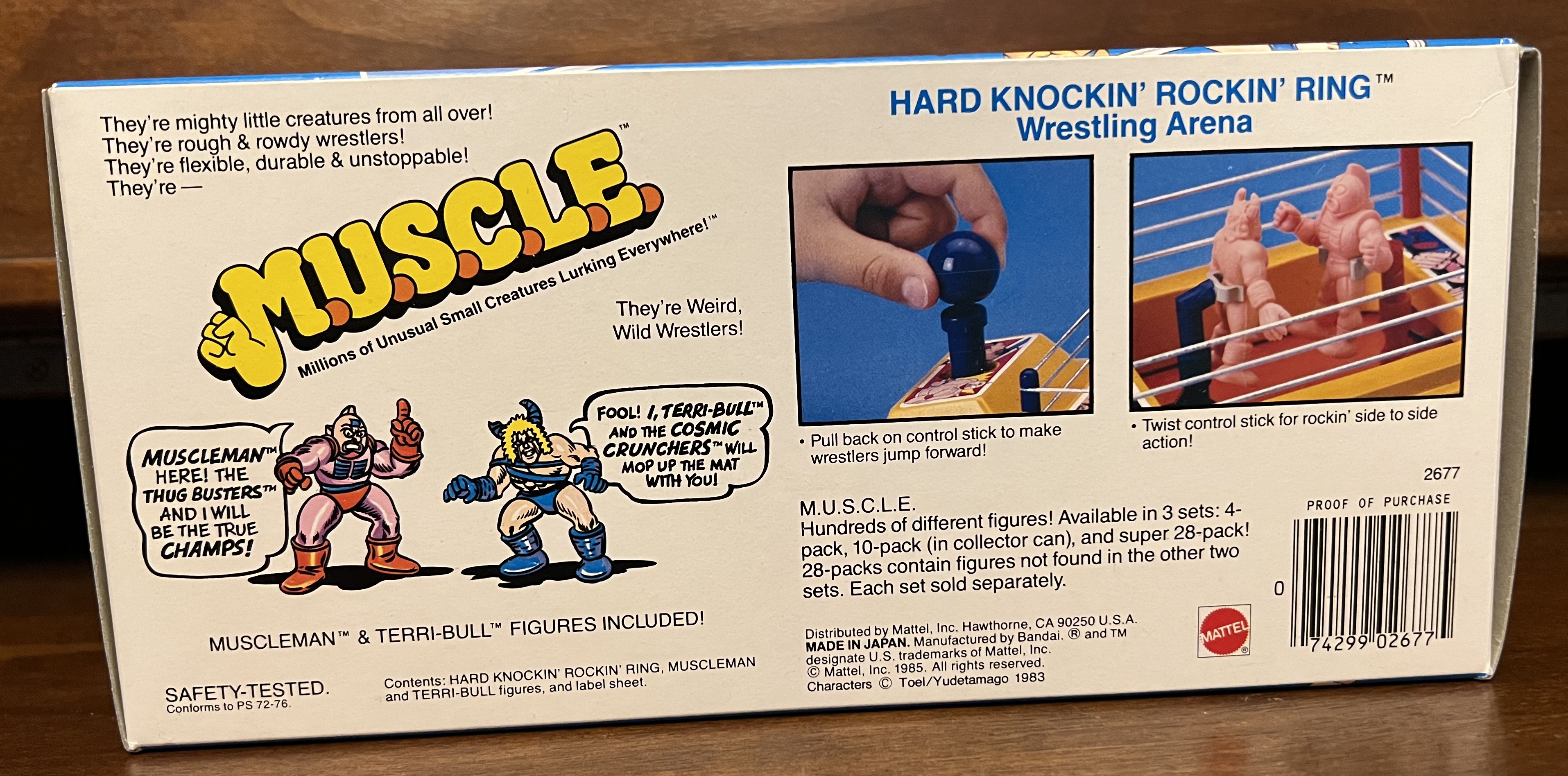
While the back of the 4-packs sets up the hero and villain, it was the back of the 28-packs that gave us the closest thing to a backstory, with an included comic strip! I suppose no other item in the line had enough room on its packaging:


Speaking of Bandai and keshi, the 28-packs always remind me of their awesome Ultraman sets (which are sets of 30 figures):


Every great toy line needs a playset, and the crown jewel of the M.U.S.C.L.E. toy line was what every fan wanted:  the wrestling ring.


It wasn't even that large of a playset, but the concept of joysticks to move your figures and make them fight was brilliant.  On paper. Unfortunately, it's probably for the best that I didn't get one that Christmas, as they are pretty fragile.  The plastic clips that hold the figures tended to break easily (intact examples usually have white stress marks, at the very least).  But that wasn't all:  the orange cardstock that served as the floor tended to get scratched up quickly, AND the elastic bands that made up the ropes around the ring were prone to breaking or getting lost.  


Bandai produced this item themselves for Mattel.  Notice that the back of the box shows a prototype version of the playset with different joysticks, and, most notably, different clips to hold the figures! Too bad we ended up with the fragile ones. (They really should've been metal.)

We mentioned the rare light-purple color.  There was also a board game, which included ten figures.  What's important here is that, while light green was already an existing color, the five lavender-colored figures in the game are the only ones ever produced that way.  Because of this, complete examples of the game can be tough to come by.


We have already mentioned the mail-away poster, but for completeness, there was also an NES game, a FREE figure in select jars of Nestle Quik (that was awesome), and something called the "Battlin' Belt" that was the Kenner Chewbacca Bandolier Strap of the M.U.S.C.L.E. line.  I see what they were going for, but I thought it was dumb, even as a kid.  However, these are the types of items that always end up worth a fortune, because fewer people bought them originally.  


All in all, one thing you can definitely say about this toy line is that it causes hardcore nostalgia.  It's certainly one of my favorites from the 1980's.  Discovering its origins and finally getting questions answered through some great websites (links below) has been extremely rewarding over the years.  I've noticed in recent years that you just don't run into the figures like you used to.  It used to be commonplace to see a couple in a random bag of toys in a thrift store, but that never happens to me anymore.  I'm sure they are being hoarded, because prices have been climbing! 

If you are interested in learning more--much more--about M.U.S.C.L.E., here are some places you should go:

The University of M.U.S.C.L.E. - This is the definitive website on the subject.  Do you want to know which figures were available in which colors? Are you curious which figures make up the different 28-packs? They have the answers.

Nathan's M.U.S.C.L.E. Blog - Jump to each figure by number, and see exactly how and where it was available! Great in-depth info also on each type of item in the line.

2/20/15

Beany & Cecil Glass Marbles (No Manufacturer, circa 1962)

 A recent purchase of mine--photos lazily cribbed from the auction itself.  The only difference in the front and back of the header card is the large price.  Imagine getting anything for ten cents.  Even marbles made of glass were better looking back then.

1/15/15

Hand-made Vintage Beany & Cecil Statue! (details unknown)

We are nearing the end of my trove of Beany & Cecil collectibles, and we still haven't even covered my rarest, and most unusual, piece.  And I haven't even had it that long! Last year, I was skulking my favorite thrift store, which I try to do at least three times a week, when my eye caught something at the other end of the store.  It was green, vertical...and my brain suddenly locked onto it.  As I began to head that way, walking faster, my strangely disconnected mental inventory began to suggest to me that it was Cecil, the Sea-Sick Sea Serpent! Could it be a Soakie (bubble-bath type vintage product) bottle? The next thing I saw was a wooden base...a lamp of some kind? There were such things...and by then, I was close enough to see what was lying beside it..........in pieces! Egads, the find of the century, and I don't even know what it is, and it's broken!
I began to pick up the pieces, my poor, disjointed brain still reeling in the throes of "thrift-store discovery ecstasy," and it quit sending me suggestions as to what I was looking at.  The largest piece was definitely Beany Boy...followed by a leg...and then a foot...and then some crumbs.  Was this thing even fixable?
Stream-of-consciousness thoughts began to form, and then taper off...did some disgruntled thrift-store employee just chunk it on the shelf, haphazardly?  Why, the nerve of...but then again, maybe it was the method in which it was donated, so it wasn't even packed right...or somebody died, and it was cleaned out of their belongings....or a maniacal ex-wife threw it out.....
I snapped back to reality, and began to carefully place the existing pieces together.  The good news was that it appeared to have broken in the store, so it should all be accounted for...and it was!  The pieces pretty much fit together very well, so this treasure could be repaired....but what in the world was it?
The ending to my thrift-store adventure was that I took it to the front, showed them it was broken, and got a 50% discount (yeah, I know, but I wasn't about to argue).  The girl did say, "well, at least you can restore it, and put it back together again!"
After carefully transporting it home, I took inventory of exactly what I had.  I neglected to take photos of the wooden plaque that was used for a base, but it had an old-looking rubber stamp on the bottom from a woodworking company in Dallas.  The address included a ZIP code, which means it the oldest it can be is 1963...which is just the base, of course.  It could have been added at a different time.
And now to the materials...exactly what was this object made of? I've had some experience with different materials, and the natural choice would be Sculpy, but the problem here is that both characters are SOLID.  The assembled statue is heavy, and there's no way that Sculpy would bake thoroughly...in fact, you would build over a "filler" like balls of tin foil because of that fact.
Take a look at these pairs of photos, both with and without a flash:

You can see that the innermost core of the material is yellow, and the outside is almost pink.  The characters are held to the base by large wood screws.  Here is another view:

The yellow color reminds me of dental-stone.  This is the material that was always used by dental labs to make positive models of the impressions taken of patients' teeth.  The problem with this theory is, dental stone is mixed up as a liquid, like plaster, and then pored into a mold.  There would be no way to do any sculpting to it, and the characters have evidence of some sculpting being done, and also exhibit several fingerprints from the maker.
The material crumbled pretty easily at the break, but was otherwise very solid and dense...was there some sort of modeling material sold in vintage craft stores that would allow for this sort of method?  It's certainly not plaster; it's the wrong color and completely the wrong density.
So, maybe some "real" sculptor's clay that has to be fired in a kiln?
Luckliy, everything came back together very tightly--and, I should point out, Beany's propeller somehow avoided any damage in the handling of the piece, which is a miracle.  I will admit to one other restoration, though--Cecil had no eyelashes, only blank spots where they used to be, and it made him look just WRONG.  So, a trip to a craft store to procure some purple felt was in order.
I've unearthed a few mysteries on this blog, and I hope I have solved a few as well, but you can add this one to the pile.  Was this made by a devoted fan? Is it some sort of maquette? How old is it? I hope the photos show the level of detail involved.  It's not only expertly painted (with some high-quality paints, too, as they have stood the test of time), but the detail is admirable.  Cecil has the baggy folds that suggest he is a puppet.  Beany is squatty and proportional.  And what in the world is it made of?  Something somebody smuggled home from work, bought somewhere, or had lying around professionally??? And how in the world did it get to the American South????
I'm just cynical enough to know that I will probably never get answers to these questions, but one thing is for sure:  I will treasure this piece, which will sit at the top of my Beany & Cecil items in perpetuity.  Whoever you are, just know it has found a good home.

1/12/15

Beany & Cecil Match-It Game (Mattel, 1961)

Another interesting Mattel item that was made for Beany & Cecil.  This is a large and colorful game, and I must confess when I first got it, I thought the goal was to fit pieces in that matched adjacent pieces all the way 'round, and once I read the instructions, I found out that wasn't the case.  (Nevermind that, if it worked the way I thought it did, it would be a pretty impossible kids' game!)
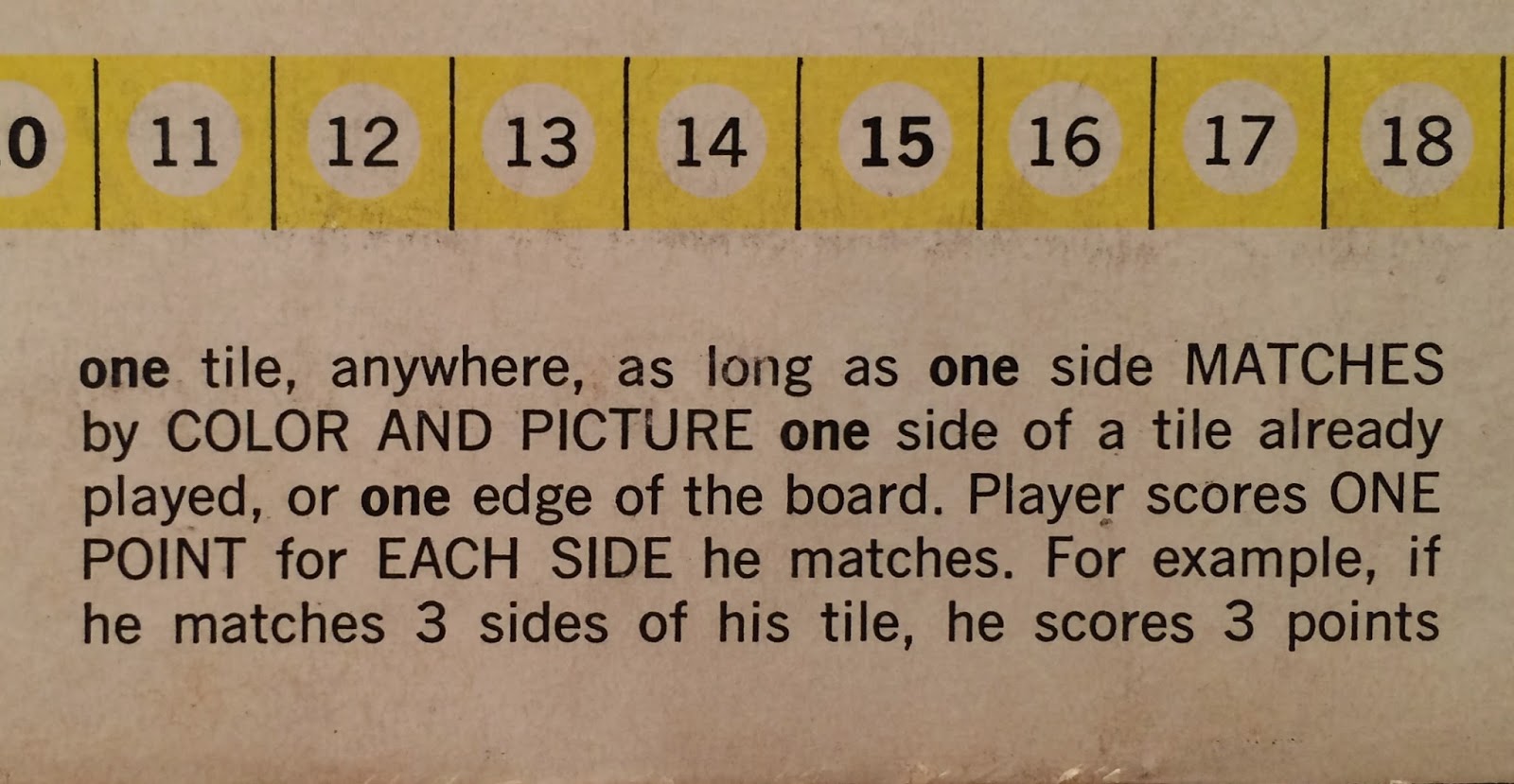
Besides the matching element of the game, it also had a board game component, as players advanced on a track of their color for each match they were able to make.  The playing pieces punched out of (and were stored in) the game board itself, which is always precarious for posterity...but somehow, they are all still here.
The instructions are below.  And like I said, it looks like the player only has to match, at least, one side, and more if possible (which moves you farther along the game board to victory).


1/9/15

Beany & Cecil Ring Toss Game (Pressman, 1961)

Mattel didn't make all of the Beany & Cecil items from the animated TV cartoon.  Pressman made their fair share as well, and here is a good example.  This is the Beany & Cecil version of the classic "ring toss" game.
The graphics on the metal base are really great, and I like how each of the five posts correspond to a particular character...but they even took it a step farther, as each character is interacting with their post in some way (Cecil's is in his mouth!).
For a long time, I had the metal board hanging on my wall, as it makes such a cool display.  It strikes me that I haven't seen a complete one of these games since I bought this one several years ago, but I'm sure the more they were played with, the less they survived!
Box art (photo taken years ago from Ebay)

1/7/15

Jumping DJ Surprise Action Game (Mattel, 1962)

This is a neat item, but it strikes me that for Mattel's Beany & Cecil output, especially what we have looked at so far, it's pretty uncomplicated.  Still, it's nice to see the villain of the piece get a game that features him. 
Speaking of Dishonest John, while this looks like a puppet, and would make perfect sense if it were, it's actually a head on top of a metal frame, covered in a black vinyl bag of sorts.  Basically, you push down on his head, and he later pops up at random intervals, which I suppose figures into the game play (this is the "Surprise Action").  The metal scorekeeper device is actually built into the box, allowing up to six people to play the game simultaneously (and it tops out at 250 points).
Here is the instruction sheet for the game, which sort of works like Old Maid.  You make groups of cards, being careful not to get the DJ card, which actually TAKES AWAY 30 points.
And speaking of the cards, they are the real stars here.  Four of each character are included, with the artwork directly in the style of the TV cartoon.
 The lower left card shows the design that is on the backs of all cards.  At lower right, the nefarious villain card that you don't want to get!

1/5/15

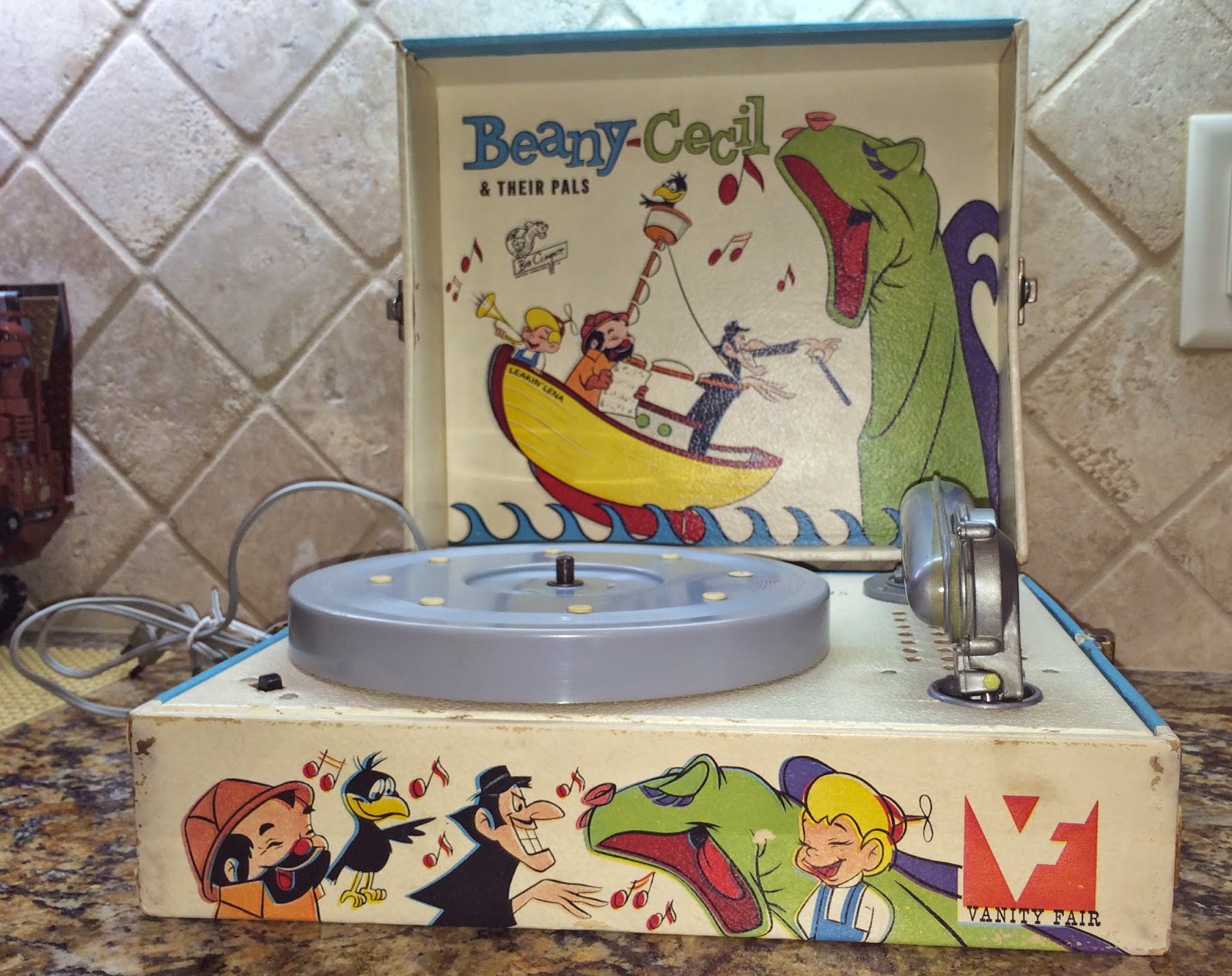
Beany & Cecil Record Player (Vanity Fair, 1961 or 62)


Here's a lovely item, and it brings back memories of portable record players--the kind that were in bedrooms, schoolrooms, and Sunday Schools.  Of course, record players never really fit into the definition of "portable," and if you had to also carry a stack of records, you had some heavy lifting to do, but it was still a wonderful time.
I had to do quite a bit of restoration to this one, as all of the images were printed on heavy stock, very much like wallpaper, and every edge was peeling, due to the ravages of time, and probably, storage.
Just look at that chunky stylus! It looks like metal, but it's actually plastic.  You can't really tell from the photo, but the two speeds are 78 and 45 rpm!

12/31/14

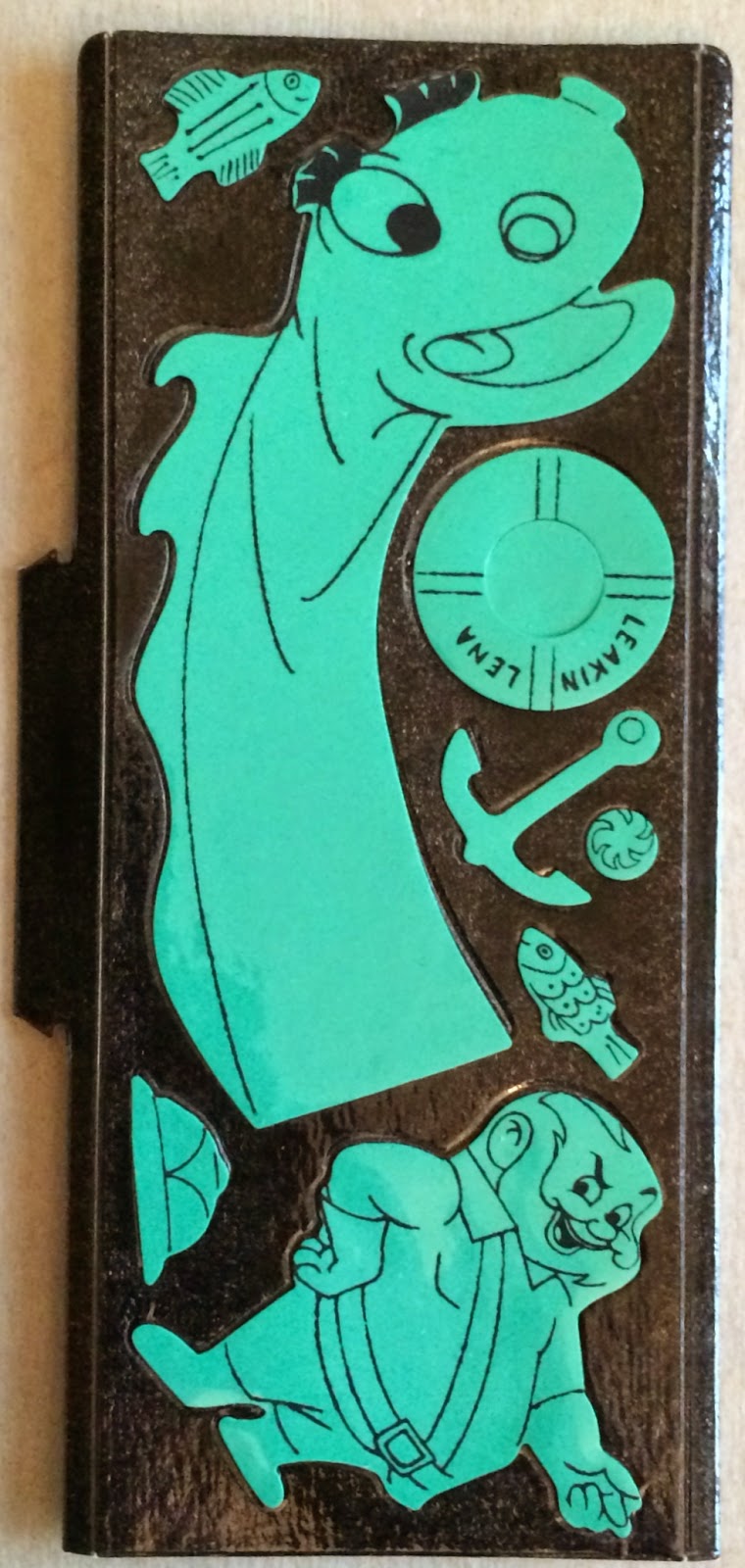
Beany & Cecil Cartoon Kit (Colorforms, 1962)

And now, back to the Beany and Cecil Onslaught...more than one generation of children grew up with Colorforms, amazing and simple playsets that allowed hours of fun and customization, long before computerization took over.  Colorforms were available in just about every franchise imaginable; I still have my prized Pac-Man and Spider-Man sets...no Star Wars though, although today I bet there would be.
The description on the box explains how they worked:
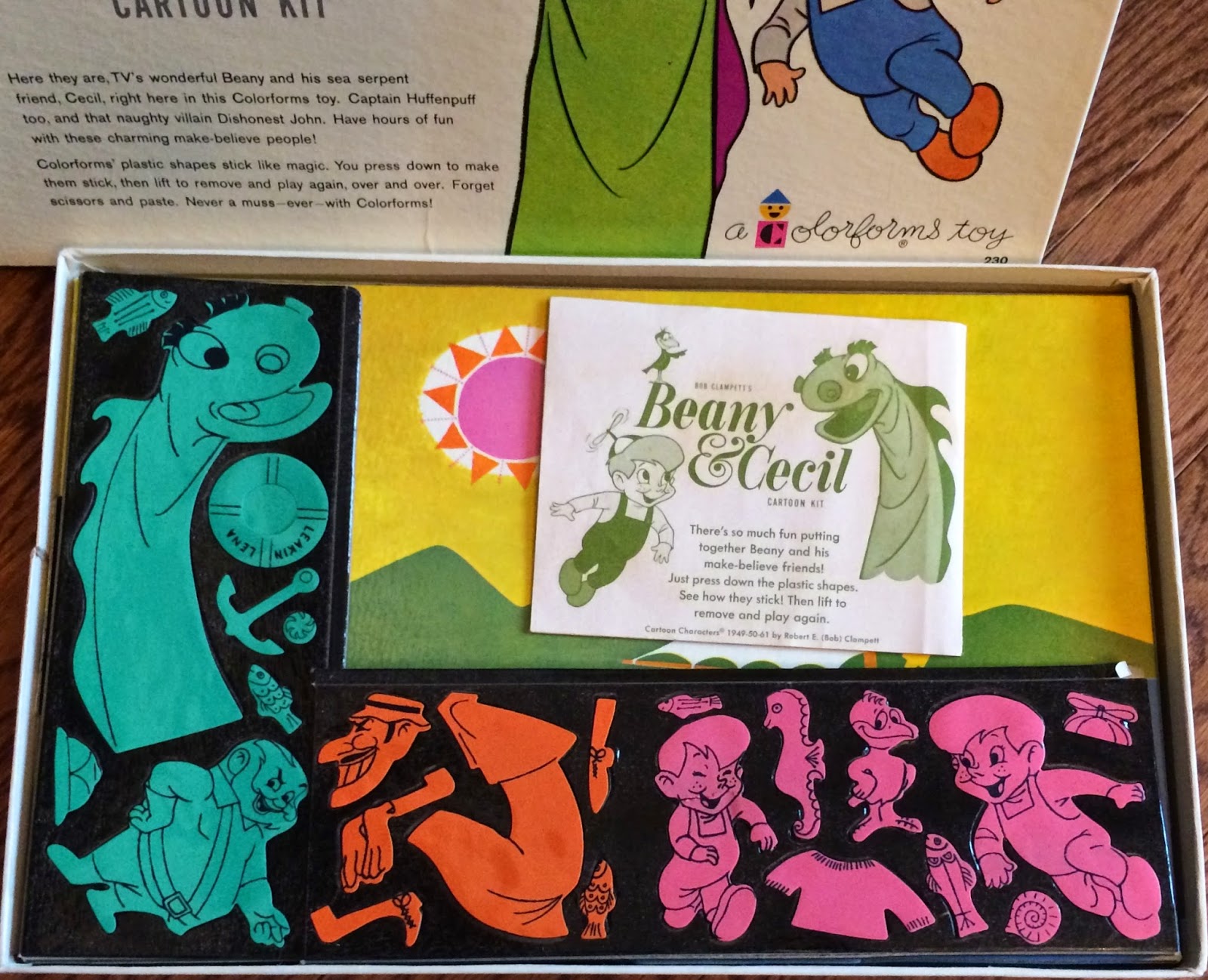
Colorforms sets consisted of a plastic-coated backdrop, which fit into the lower half of the box.  Pieces were stored on removable flaps that were held into the backdrop by slots.  This insured that everything had a place for storage, which is always a good idea.
For a Spider-Man set, the backdrop is a cityscape; for Beany & Cecil, it is the beloved "Leakin' Lena," naturally with some sort of body of water for Cecil to populate.  Now, let's look at the pieces included:
The first card holds Cecil, Captain Huffenpuff, and some accessories, although I'm a little confused as to what the little round thing is...a throwing star? A peppermint candy?  These were usually the first pieces to be lost, although the original owner of this set was pretty fastidious, I have to say...even the filler piece inside of the life preserver is still present!
The second card has the villain, Dishonest John (or "DJ").  It's cool that Colorforms separated his body parts, because it allows for more poses during play (or amputation).  We get two different poses of Beany (with separate Beanie), and some random pieces.  The bird is actually Crowy, who belongs in the crow's nest, but we also get an oversized mutant seahorse, a sweater (?), another fish, and a snail shell, which is a bit puzzling.
And finally, the booklet itself, which is a great find, because like the tinier pieces, this would also be completely discarded:
"Besides, Mother will thank you!" I can feel the teeth of a thousand feminists grinding! Can't Father be responsible for the little snot once in a while???!?!
Some of the other sets listed are interesting (well, okay, not Shari Lewis, that's nightmare fuel), and are from a wide range of licenses.  If you want them, all you have to do is ask your local "toyman." Wait, what?