11/2/20

The Unused "Monsters of the Movies" Godzilla Model Kit That Shouldn't Exist


As we have discussed here (for a full history of Aurora's Godzilla model kits, containing everything you need to know, see this comprehensive article at Sean Linkenback's Showcase Daikaiju!), Aurora produced a "Monsters of the Movies" series in 1975.  

These kits were designed by the late, legendary Marvel artist Dave Cockrum.  However, another of the designs he submitted was for a Godzilla (you can see a photo of the prototype, now in the hands of a private collector, at the aforementioned link).  This went as far as being sculpted by Ray Meyers, but, for reasons unknown, never saw the light of day.  

But then, a couple of years ago, as my Ebay seller wrote, "someone got a hold of [the] Aurora patterns...took the resin kit to make styrene plastic kits." My understanding is that a limited run of 100 were produced, and quietly sold online for a short time.  It's my belief that the leftovers of this run are what has recently been sold off on Ebay.  

At 7" tall, the kit shows Godzilla in a dynamic action pose, with one foot plantarflexed behind him as he steps forward to lean over a destroyed Tokyo Tower.  What's even cooler is, he holds remnants of the tower in both hands! This would've been a strong addition to the line of models, and, honestly, would've offered a huge amount of star power.  The closest Aurora Godzilla to the M.O.M. line was the 1972 glow kit reissue, and it didn't match Ghidrah and Rodan nearly as well as this design would've.  

The kit is without instructions or box, since it never got any farther in the design stages.  However, I can only thank "someone" for making it possible to see what this part of Godzilla history would've looked like, in three dimensions!


10/30/20

Basil Rathbone Reads Edgar Allan Poe (Caedmon, 1960)


By luck, I just found this LP at a flea market last weekend!  Happy Halloween, but don't consider this a timely post:  I was greatly offended the other day when somebody asked me, "What's a good monster movie I can watch for Halloween?" I responded, "Monster movies are not Halloween movies...they are everyday movies."

10/20/20

HEY YOU GUYS! An Electric Company Collection - disc three (Leaping Fox)


Today we conclude our three-disc set paying tribute to THE ELECTRIC COMPANY, one of the greatest things that ever happened.  Where our previous discs focused on lots of material that was put out on records, this last one is 100% audio from the actual program.  In other words, here are songs that not only were presented on the show (you can compare a couple that are here to their LP versions), but also several that accompanied some amazing animated segments and short films that made up the program! There are some real gems here, because, as I mentioned before, they were written and performed by extraordinary talent, rather than tossed off by disgruntled kids' show staff who were paid to fill space.  Just try--TRY, I dare you--to get past tracks like the stupendous "Right On" or "This Lollypop is Following Me" without repeating them in endless loops, over and over.  Try not to marvel at "Boris the Boxer" or wallow in nostalgia with "There's a Hole in the Bottom of the Sea." Also try not to be drawn in by the pure unrelenting funk of numbers like "Steady Freddy," "Hey Diddle Diddle," or "TION."  It was a great time to be alive.

Which leads us to the point I made earlier, about what we can't enjoy because CTW or United Sesame Socialist Republic, or whatever they are called now, won't release it.  I'd put money on the fact that, like me, you are thinking of some EC songs right now that you can only hear in your dimming memory.  For me, it's "I'm a sloppy, sloppy, sloppy slob!" or the one I want the most, "I would, if I could, but I can't...so I won't!"  Anyone remember those? We can only hope this, like so many wrongs in the world, are one day corrected! In the meantime, enjoy this final disc!


10/15/20

HEY YOU GUYS! An Electric Company Collection - disc two (Leaping Fox)


Continuing with my new set paying tribute to THE ELECTRIC COMPANY, here is disc two! This disc starts where the last one left off:  the presentation of the two book-and-record sets concludes the recorded output that was officially released (and, the scans for the books are also included, so that you can follow along).  

The stellar theme for the show was one of Joe Raposo's finest moments (in a long list), and the next section presents all of the various versions, spread across six seasons, with both opening and closing themes.  (There are some extras, too, such as an officially-released unique version from a promo 45, a unique mix from a documentary, and even an unusual "cover" version from a children's record.) Some of the daily promos were also included, because I know that in the minds and hearts of fans who grew up with the show, they are part of the themes to them! 
Any discussion of ELECTRIC COMPANY themes must not leave out the Spider-Man segments, which included an incredibly iconic and memorable theme by Gary Friedman. The different versions are included here, as well as the full-length one that he released on a promo 45 in 1975. Next, we have an example of one of the most famous EC segments, Letterman! I included it here, as opposed to disc 3, because of the great music that these segments had (as well as great voice actors).

Finally, no discussion of the ELECTRIC COMPANY is complete, either, without including the songs that Tom Lehrer supplied for the show.  Long-time visitors to The Sphinx will know that we are huge Tom Lehrer fans here (search this site for SEVERAL Lehrer rarities that I moved to Google Drive, to maintain the links! In fact, Mr. Lehrer was kind enough to allow me to keep offering them here!) There are actually a couple of items here that got left out of my TOM LEHRER RARITIES sets, while everything else has been improved in some way, so don't miss these!  Unfortunately, the tenth and last Lehrer ELECTRIC COMPANY song (entitled "Without an S") still remains unavailable.  However, the info section of this download does include the lyrics, so we can have some idea of how this would have sounded. This section concludes with a 9&1/2 minute interview Mr. Lehrer did that was included as a bonus track on the ELECTRIC COMPANY GREATEST HITS AND BITS documentary.

Like I said, don't miss this one! Enjoy! DISC TWO HERE.

10/12/20

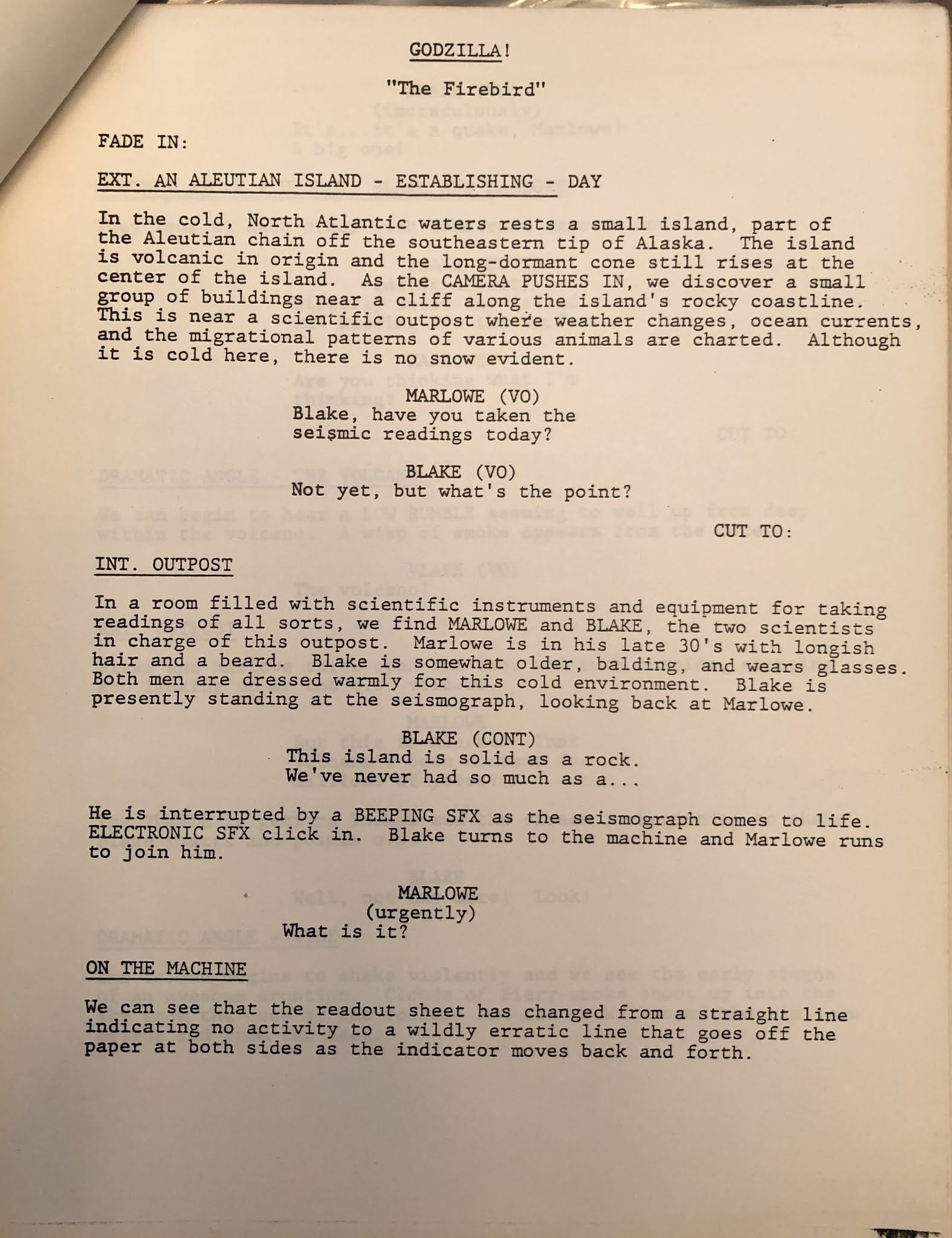
GODZILLA - "The Firebird" (Hanna-Barbera Pilot Script, 1978)


Here is something I picked up in months past.  This is a production-used script for the first episode of the Hanna-Barbera GODZILLA animated series, which was called "The Firebird."  It's dated March 7, 1978 and runs 52 pages.  My original intent was to scan it, but when I unpacked it, I realized I didn't want to undo the way it was stapled together...so instead, I took some photos of some key pages to share, so that you can get a look behind the process of what animation used to be like.  Note that the front of the script bears letters "HAK" written in pencil, which I believe is a someone's initials who was associated with the show.  If you know who, please chime in!


The next few pages include an action-packed battle between Godzilla and the monster of the title:


And finally, the end of the battle, as well as the end of the episode, complete with goofy Godzooky moment [ "APOLOGETIC HONK"]:


10/7/20

HEY YOU GUYS! An Electric Company Collection - disc one (Leaping Fox)


I still get the urge to make compilations every once in a while, and here is the one that's been at the top of my list for a long time.

What can't be said about THE ELECTRIC COMPANY? If you were around and watching public television as a kid, between the years of 1971 and 1985, then a great deal of your training for reading came from this amazing show.  It was wonderful, trippy, and hilarious; written in ways that didn't insult the intelligence of the viewers who were the target audience, and was accomplished with a dream team of cast, writers, and musicians (this is the part where people always talk about Morgan Freeman, but the entire cast was equally omni-talented).  It overflowed with sketch comedy, cool animations, and surreal visuals from the cutting-edge technology of the day, like Scanimate and Chroma-key.  It was the cooler older brother of Sesame Street, and, beginning in 1974, it had the first official live-action portrayal of Spider-Man, ever. 


Amazingly, though, in comparison to CTW's cash cow that was Sesame Street, The Electric Company had precious little merchandising.  You can very nearly count the items on one hand.  Sesame Street, of course, had a flood, and seemingly cranked out records by the day, but The Electric Company was only allowed to produce a total of one LP featuring songs and cast members from the show.  Which is ironic, because the program featured some of the same geniuses writing the songs...and there were tons of songs! (But, of course, no Muppets to serve as mascots for the show...Electric Company tried a Scanimate chicken puppet early on, but it didn't stick.)

After six seasons, the last two were repeated for several years...and then, it disappeared.  Fans (including this author) wrote letters to CTW, and the hold-up seemed to be that they were slowly preparing to launch their own network, NOGGIN (I remember their return letter even saying something about this), but even when that happened, they only utilized a very small percentage of the 780 episodes available.  NOGGIN, of course, went away, and after some time, Shout Factory released a boxed set of DVD's featuring episodes from the show, in 2006.  It wasn't perfect, and some episodes were messed with [supposedly licensing only allowed for a couple of Spidey segments to be included...which makes no sense at all], but, needless to say, the set was enormously popular, and a second one followed. After this, two groups of 15 episodes were placed on iTunes (and are still there), almost as if they were intended for another box set that fell through.  

And then...well, since that time, we have been back in the "nothing happened" category. Hundreds and hundreds of complete episodes remain in a vault somewhere, including tons of skits, songs, and Spidey segments that only exist as faint memories in the back of the minds of aging fans.  Apparently, no one is interested in making these available, and as we all know, few studios are taking any risks or spending any money these days.  But, wouldn't an online archive, at the very least, be a feasible possibility? After all, these shows could be carrying on their work of teaching upcoming generations to read.

And that's what this set debuting here today is about:  preserving, and celebrating, the audio of The Electric Company, because nobody else will do it. There will be three discs total, and this first one will present their only two LPs.  "Wait--" I hear you cry, "up above somewhere, you said there was only one LP made!"  Yes, yes I did--this is because the second album was comprised of Spidey Super Stories adventures and issued on Peter Pan Records.  But, hang on, we will get to that momentarily.  Here is what's included on the first disc:
1) THE ELECTRIC COMPANY (Warner Bros. Records, 1972).  This official cast LP works like an audio episode of the show.  It features the first-year cast, includes two Tom Lehrer songs, and is quite entertaining overall.  It was issued more than once, the first time with a die-cut cover, which featured a turning wheel--in other words, it's LED ZEPPELIN III, except teaching kids to read.  The LP also included a 24-page full-color book, which I have dutifully scanned and included herein! 
I should point out that later editions omitted the cover feature, but still included the book....except for one bizarre 1974 "budget" edition with a totally different cover, that was on Sesame Street records.  This strange version cut out over 15 minutes of content, and severely edited other tracks.  [Upon close inspection, it dawned on me that all of this was apparently done to remove Bill Cosby completely, as he had left at some point in 1972....today, somebody would do this for an entirely different reason, of course.] 
The tracks that were edited are included as bonus tracks.  All of the album covers are included in the Info section, as well. 

2) SPIDEY SUPER STORIES (Peter Pan Records, 1977).  Around this time, a deal was made with Peter Pan Records to produce some read-along storybook sets [of which there are two, which will appear on disc two], as well as this album, which brought to life some Spidey Super Stories adventures from the show and the comic of the same name.  I can say nothing more except:  I wore out my copy of this LP.  I carried it to school.  I had it memorized.  I made my kids listen to it over the years....It is sacred to me.


In the following two discs, we will present The Electric Company theme and all of its many permutations from the six seasons, other segment themes, some other surprises from the show, the canon of Tom Lehrer songs written for The Electric Company (one is still sadly unavailable, I'll tell you right now), and many more song favorites, so stay tuned.

Paul has five seconds to read the next words...can you read them before he doesDOWNLOAD DISC ONE HERE.

RODAN / GORGO Double Feature Ad Slick!


Here is an ad slick for a dream double feature of GORGO and RODAN! How cool is this?!! 

It only serves to remind me, in this sad time, how dreadful the state of movies, and theaters, is today.  (You can take that statement either way, but I mean aside from the virus.)

10/6/20

GODZILLA'S REVENGE / WAR OF THE GARGANTUAS / MONSTER ZERO Triple-Feature Ad Slick (UPA)


Here is a great ad slick for a triple feature of GODZILLA'S REVENGE, WAR OF THE GARGANTUAS, and MONSTER ZERO (of which, the latter two were already together in the US).  Just drop me off early, Ma, I am staying at the theater all day! What a dream.

9/28/20

GODZILLA 1985 Ad Slick Set (American Screen Accessories, 1985)


Here is a 4-page set of ad slicks for GODZILLA 1985.  No doubt they were intended to accompany the GODZILLA 1985 Press Kit that we have looked at in the past.  Either way, they make a nice complement to it.


9/7/20

SON OF GODZILLA 1" Type C TV Station Library Master Tape

 NOTE: LINK HAS BEEN TAKEN DOWN AGAIN, DUE TO SPACE CONSTRAINTS--STAY TUNED


I was lucky enough to acquire a 1" master tape from a former TV station library, and get it converted to DVD.  As the film was not released in theaters in the US, the tape contained the 1969 American TV version of the film, meaning the beloved Titra dub (not available on DVD)!  There are also some other differences from the Japanese version, including:  no brief opening scene with Godzilla, a unique title card, textless opening credits, and a unique ending card.

What I haven't done is compare this to one of the gray-area VHS releases from the 1980's and 90's (of which there are only a scant few; see my page on Godzilla VHS for info).  I'm assuming companies like Video Treasures used a tape like mine as a source, but I haven't yet confirmed it.  The 1" tapes used by TV stations contained more lines of resolution than VHS did, so hopefully, even if this copy is identical, it's an improvement.  

And, for a short while, it is available here: SON OF GODZILLA (TV Master Tape).  This is the VIDEO TS folder straight from the DVD conversion, so drop it into the burning software of your choice. This will not be left up as a permanent part of the blog, due to space, so grab it while you can.

(Inlay artwork for transparent case)

8/21/20

GODZILLA in America: the 1960's (part three)

Today we wrap up the entire decade of the 1960's, showing the last third of official American Godzilla items produced!

"King Kong" Trading Cards (Donruss, 1965) [continued]

Here are the five remaining cards from the Donruss King Kong series, which include #32, 33, 38, 39, and 42. As I pointed out last time, #32 doesn't even have Kong in sight, so that was a very interesting choice (as well as a pre-supplied lobby card promotional photo that took no additional effort, so draw your own conclusions). Like many other monster cards of the era, this series had the blight of "goofy captions," which were a silly product of the times. (Don't get me wrong: I'd trade now for then.)

"Monster Cards" Trading Cards (Rosan, 1965)

Almost an honorable mention, because Godzilla doesn't appear in this strange, "lo-fi" series, but Rodan does, so it's included here (this photo gives me GIANT CLAW flashbacks, though).  There was debate whether this cheap-feeling series was really official or not for some years.  While all trading cards were cheap to produce, they were not all equally licensed!

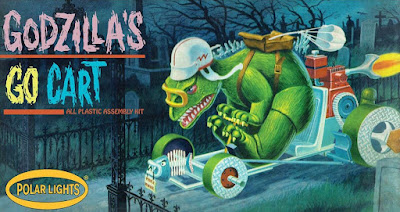
"Godzilla's Go Cart All Plastic Assembly Kit" (Aurora, 1966)

While the first Aurora kit is the symbol of American Godzilla merchandise, this, then, is the "holy grail."  Take everything I said about the rising values of the first Aurora kit, and quintuple it.  Now, roll a 20-sided die, and multiply everything by the number you get.  Take the nostalgia recipe I mentioned before, and stir in the mid-60's "hot rod" craze, and now you have a deadly potion that will stop the most steadfast collectors in their tracks! 

I'd like to say you may even ever see one of these in your life, but I doubt it.  In the last 20+ years of collecting, I have seen one empty box on Ebay (sold for over $1,000 in 2012 or so), and one completed model as in the photo above, but not nearly as well-painted (and I don't remember it selling? It would today!).  [Edit: a built-up and painted model with no box or instructions sold for $2025 on November 21, 2021.]

It was part of an entire series of "monster kart" kits (all equally ridiculous) that included Dracula, the Mummy, and King Kong, and if nothing else, it's an interesting early example of grouping Godzilla in with the American movie monster pantheon, which became a commonplace practice by the 1970's.  Over the years, there has been a theory that Toho shut down production of this model, but that isn't true.  Still, it quickly disappeared.  In 2000, Polar Lights reissued the kit and removed Godzilla's name, and Toho did object to that one, so maybe this is where some of the confusion comes in.  The reissue has become an important placeholder for many collectors! [Edit, again:  In December 2021, Polar Lights again re-issued the kit, this time under its full name!]

Does it go without saying that, if you have one of these for sale, I'd like you to contact me, so I can complete my entire 1960's Godzilla decade? ...No? ...Anyone?

"Godzilla Bicycle License Plate" (Marx, 1967)


This embossed beauty is as equally rare as some of the above pieces that we've discussed, but doesn't quite command the Aurora-level prices like black market organs do.  Made by the great Louis Marx company (another name that ensures love--and resale values--among collectors), it's said that distribution on these were quite low, and that they were more common in the north, toward Canada.  The rest of the line included characters from Marvel, DC, Jay Ward, Disney, and....Soupy Sales (huh?), and you know what would have been on my bicycle.  But, luckily, this one wasn't, or it wouldn't have survived nearly so well.

"Godzilla All Plastic Assembly Kit: Glow in the Dark" (Aurora, 1969)


Oh no, we are ending the decade with another Aurora model kit! The first Aurora kit was wisely reissued in 1969, and was pretty much identical, only this time, a sprue of interchangeable glow-in-the-dark parts were included, allowing you to switch out Godzilla's head, hands, fins, tail, and nameplate.  Before you give this a 21st-Century "meh," imagine going to sleep as a tyke in that era, and when the lights went out, there was Godzilla, glowing monstrously at your bedside! Now, that is cool.

It's not pertinent to these articles to mention that this version of the kit was reissued in 1972, but it is important to point out that the boxes are slightly different.  The 1969 kit comes in a "hard box," while the 1972 comes in a thinner one.  None of this helps you if you can't handle the item, or see enough of it (such as in an auction photo, or behind glass), so consult this post for the differences between the two boxes, on all sides.

Lastly, it probably goes without saying, but of the two glowing reissues, the 1969 kit is the more desirable.  While all vintage Godzilla kits are obviously valuable, the 1969 one is the one you want to track down, like yesterday.


We hope this journey through the 1960's has been educational.  I know that it was eye-opening to me, proving that although it was a comparatively small output, it was more than "a handful." (Maybe a small table-full.) There were a couple of unauthorized items I debated throwing in, but I wanted to keep the list as official as possible (besides, they are elsewhere on this blog).  The 1970's was when U.S. Godzilla merchandising really exploded--and,  come to think of it--when all merchandising really exploded.  That would be a long but interesting series of posts...the problem being, new stuff is still occasionally being discovered!


8/20/20

GODZILLA in America: the 1960's (part two)

Continuing from where we left off last time (which was 1963), things are about to get a lot more three-dimensional.

GODZILLA GAME (Ideal, 1963)

With regard to officially entering the American market, you could hardly have a more stunning official first item for your franchise than this game.  The beautiful and captivating artwork draws the purchaser right in, and has ensured that the game has continued to hold a high ranking among more than one type of collector for all these years.  There is a two-edged sword involved with "crossover" type items though--as we are about to illustrate with the next item in our list--in this particular case, both board game and Godzilla collectors want it, and the price for a nice specimen has continued to rise! While the game is pretty rare, especially in great shape, it is out there if you are searching, so don't give up.  

Godzilla - All-Plastic Assembly Kit (Aurora, 1964)

And speaking of continuously inflating prices, the Aurora Godzilla kit may as well be the symbolic figurehead of American Godzilla items.  This item is the perfect conflation of the era in which it appeared:  the explosion in popularity of model kits,  the beginnings of Godzilla as an icon (when movie monsters were at an all-time high), even the Baby Boomer do-it-yourself mentality comes into play here.  All of these things add up to a recipe for instant nostalgia, and in short, everybody wants this model kit.  It was mentioned above that items being desired by more than one type of collector drives up prices--and, for the record, vintage model collectors are voracious.  This kit has continued to shoot up in past years, with no signs of stopping. If you don't have it, get it quickly.  By the time the sting wears off from the price you paid, it will have gone up so much, you'll feel quite justified!

Rodan the Flying Monster (Ken Films #229 & #529, 1964-65)

And now, we move to the first Toho film that you could see in your own house! Another type of item that builds up a powerful nostalgia among collectors are the early 8mm (and later, Super 8) films that were sold to the public.  Ken Films was an early home movie company that wisely forged licensing deals with major studios, and as a result, played their part in the birth of home video.  For more than 15 years, they released an astounding amount of product (and for our purposes here, all of the Godzilla-related reels in America), eventually acquiring STAR WARS and lasting into the early 1980's.  Their first Toho film was RODAN, which came out in 1964.  
A future article will discuss this further, but it's important to point out that Ken Films were available in two lengths:  50-foot reels, lasting around 3&1/2 minutes, and 200-foot reels, lasting about 14 minutes.  From a front view (such as in a photo from an Internet auction, for example), if you have no other items to compare for scale, the box art alone will not tell you which reel you are seeing, unless you can see the item number on its spine.  The 50-foot reels' numbers always started with the digit 5, and the 200-foot reels always started with a 2.

These early Ken Films were all black and white, as well as silent (subtitles were added to the films to keep the story going).  You might think that the arrival of color and sound created more and more variants of each film, but this is not exactly the case (the above-referenced future article will detail exactly what Godzilla/Toho reels were produced).  In the case of RODAN, what did add another pair to the list was the arrival of Super 8.  The Super 8 format was invented in 1965, and quickly became the go-to format for amateur film-makers and home aficionados.  Ken Films was quick to add this format to its catalogs.  

If you are keeping track, that makes a total of four RODAN releases by Ken Films; two 8mm sizes and two Super 8.

Varan the Unbelievable (Ken Films #236 & #536, 1965)

The very next year after RODAN was brought into collectors' homes, Ken Films released VARAN THE UNBELIEVABLE, in black and white and silent with subtitles.  As above, there are also four different releases in all; two 8mm sizes and two Super 8.  

"King Kong" Trading Cards (Donruss, 1965)

We return to trading cards once again:  Donruss' King Kong set from 1965 included 11 images from KING KONG vs. GODZILLA, scattered throughout the set.  Honestly, they didn't have to include Godzilla six times (one Godzilla card doesn't even have Kong in it!), but they did, which was fortuitous on their part.  Here are the first six of those cards:  #3, 17, 19, 21, 30, and 31.  We will begin Part 3 next time with the remainder!